Flush, and then Flush
 When I first saw this sign in a men’s room in the building I work in, I thought: “Wow, I don’t want to know the history behind that one.” I do love normative signs that make compliance a matter of courtesy, though.

When I first saw this sign in a men’s room in the building I work in, I thought: “Wow, I don’t want to know the history behind that one.” I do love normative signs that make compliance a matter of courtesy, though.
 Sometimes, all you have to do is ask nicely.
This picture was sent to me by PY Neron. Roughly translated, the sign says “Don’t Steal This, Please.” PY says the chair has been sitting there, on the sidewalk outside a shop in Lille, France, for months.
 This was at the base of an escalator at a Toronto movie theatre. You know your shoes are problematic when people feel obligated to post signs warning you against wearing them.
“Hey, you! Yeah, you in the Crocs! We just can’t assume you’ll be able to figure out how to keep yourself safe. After all, you’re wearing Crocs to a movie. So please please be extra careful, OK?”

My friend Mason Cash sent me this one, from Florida. The image is actually captured from Google Maps Streetview, here: image.
Here’s what Mason had to say about the sign:
First, I love the warning…to beware of something that is explicitly labelled as merely possible.
Most road signs don’t bother to assert the possible status of the hazard, and warn of actual hazards (“wind gusts”, “children crossing”, “wildlife on road”, etc.) leaving unsaid the fact that these are only sometimes present, or explicitly identifying the times they are present (“slippery when wet”).
Second, it’s a warning intended to enable drivers to avoid a hazard. Yet this warning is given at a place in the road where you are completely committed to continuing across the lake, so its a warning about which the driver can do very little, even if there are actual (not merely possible) swarms over the lake.
Often these are swarms of bugs that don’t impede visibility significantly, but will damage to a paint job of not cleaned off immediately. So slowing down doesn’t help much. You have just passed through a toll gate and paid your $2 to cross on the bridge, and so there is no exit or anything you can take. And you are not allowed to stop on the side of the road (you are on a toll highway bridge) except in an emergency.
Giving the warning before the previous exit would give the driver the option of taking the non-toll route around the late, at least. But the choice of the location of the warning sign makes any such choice impossible.

This ‘Watch your step!’ sign would be unremarkable (in Toronto, in winter). Except when you see its location:

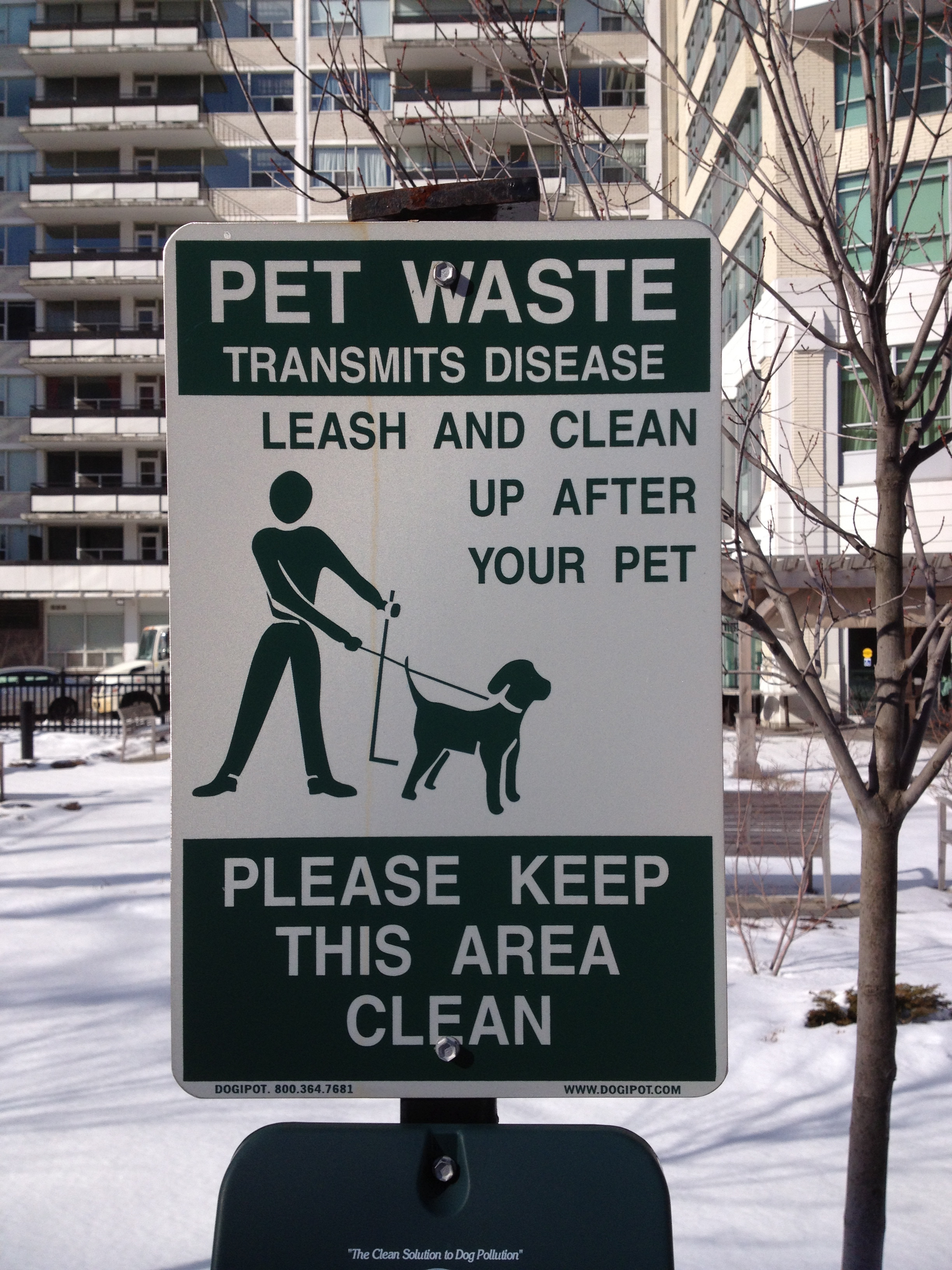 One of my core interests in starting this blog is that I’m interested in the ways in which sign-makers try to get us to do things. Often there’s more than just “do this,” but also “do this because…. This sign is a good example of that, with its nod to public health.
 This was contributed by Wayne Norman. It was taken during summer of 2012, in London. Wayne tells me the sign was a long way from any Olympic venue (but clearly a nice place for Olympic officials to stop for a pint!)
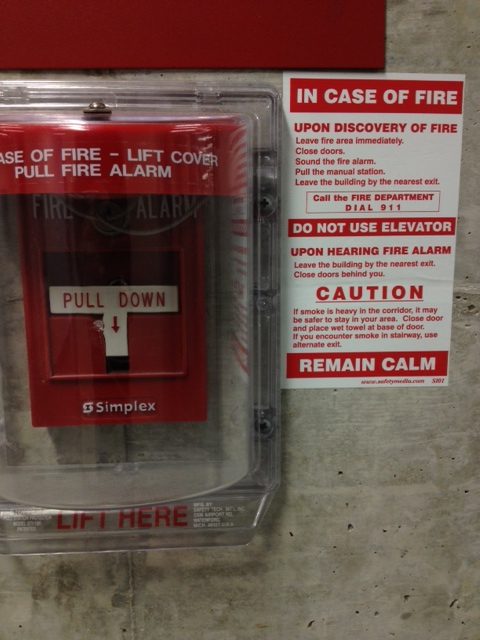 This is in the building my office is in. My thinking: in case of fire, people definitely cannot be expected to stop and read fine print.
 I love the sheer density of normative messages in this bank window. “Don’t smoke. Wheelchairs are OK. You’re being watched, so behave yourself. Oh and trust us, your deposits here are insured.”
 This one is on the escalator at the Fairmont Royal York (hotel) in Toronto. For those of you who don’t know it, the Royal York is a fancy hotel, the kind where events get held at which long dresses are not unlikely. That, of course, explains why the sign is needed. But it also suggests that long dresses may be sufficiently common that a sign like this may not be sufficient.
The sign is also interestingly lackadaisical. Long dresses may get caught. You know, it happens.
 Normative Signs: The Poetry of "Ought"