Normative Signs: The Poetry of "Ought"

In which the author finds beauty in how people tell other people what to do.

Tips Are Sexy

tips_are_sexyHand-written signs are, to me, a special category. This one is kind of great. It’s a simple declarative sentence, asserting that tips are sexy. (Frankly, kind of implausible, but hey. People find the weirdest things sexy. Hmm, wait. Is generosity sexy? Is that gender specific, or not? Anyway…) But of course, the implicit normative message is clear: you should leave a tip. I mean, you want to be seen as sexy, right?

I would love to see an experiment that tested whether such a sign is more effective than other signs encouraging people to tip.

Please…Or Else!

streetcar_fare2Here’s one from a streetcar here in Toronto.

It includes an oh-so-polite request to “please” pay the proper fare. And then a threat that says that by doing so, you’ll avoid a fine.

It’s kind of cute that they feel the need to mention that not only will scofflaws have to pay a fine of $195, but (gasp!) applicable fees, too!

No Trucks (NIMBY)

no_trucksHere’s a sight familiar in many residential neighbourhoods. Nestled within the cluster of parking restrictions: a “No trucks” icon. You can imagine all kinds of reasons for forbidding trucks on particular streets, including especially the width of the street.

But limiting trucks (and commercial vehicles more generally) is also famously an instance of NIMBY (Not In My Back Yard) thinking. This is a reminder that normative signs can have moral consequences — in particular, in terms of distributive justice.

Exercise is Incredibly Dangerous

Toronto-20130519-00628Here’s a sign giving some rather stringent advice to potential users of a particular piece of exercise equipment, located at a park in Toronto.

The list of warnings really is quite exhaustive. “Not recommended for children under the age of 14.” And “consult your physician before starting any physical fitness routine.” There are also warnings that would be obvious to anyone who just looked around: “There is no supervision of this equipment.”

Some of the warnings are impossibly vague: “This equipment is not suitable for people with general health conditions.” What on earth is a “general health condition?” And how do I know if I have one?

(Aside: this warning sign seems to belong in the category of signs that are posted purely to forestall some minor possibility of litigation. Surely almost no one is going to read, let alone heed, such a sign.)

By now you may be wondering what sort of diabolical exercise machine was seen to be so treacherous as to warrant all these warnings. Here it is….Toronto-20130519-00627

(Thanks to Nancy Walton for these pics.)

Don’t Risk Your Life

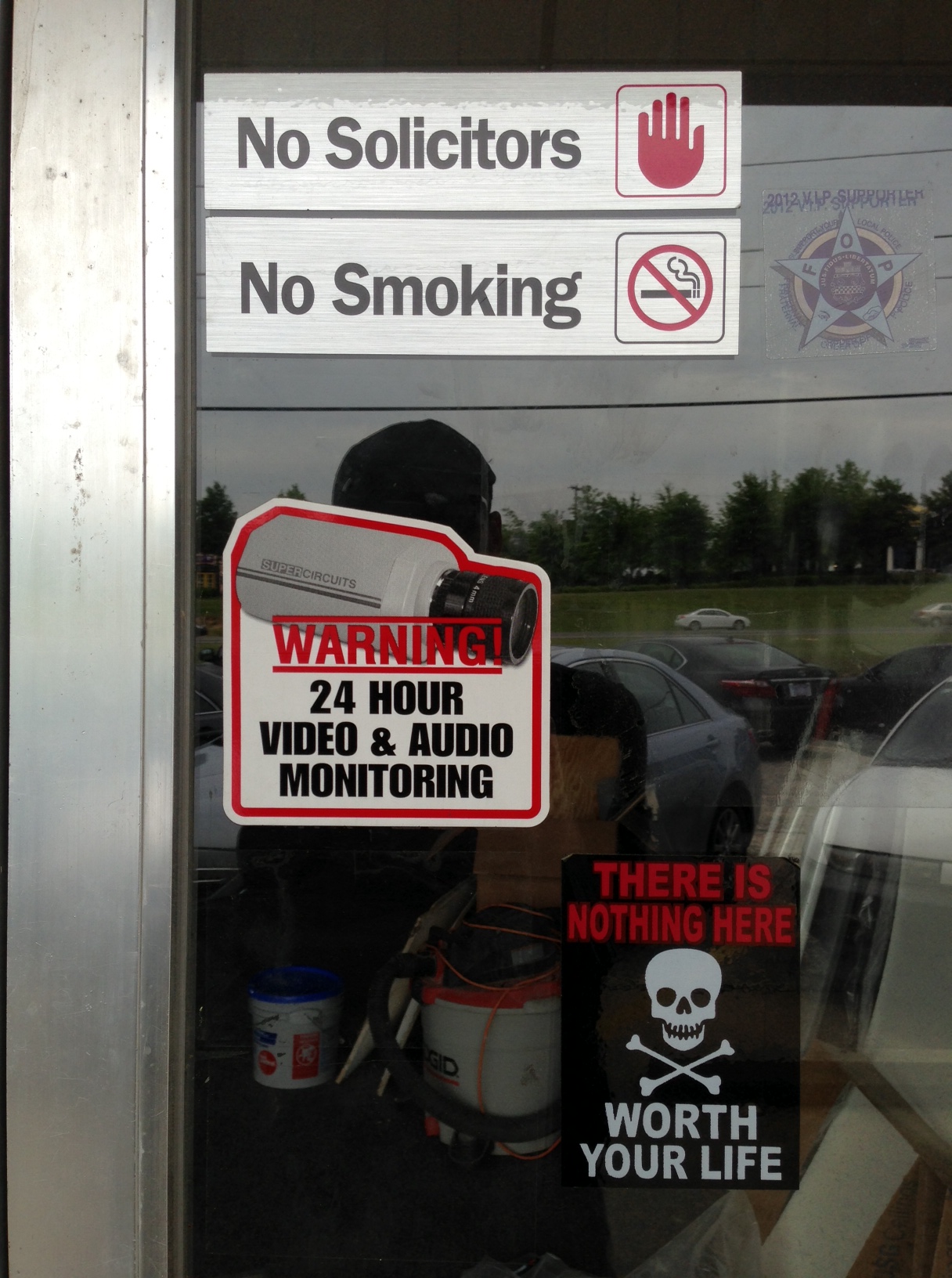
Nothing_worth_your_lifeThis sign is on the door of the former premises if a tattoo parlour, Durham NC.

The door shown here (like many shop doors, it seems to me) is another example of what I call a ‘normatively rich’ environment, one that subjects the viewer to a real barrage of injunctions and warnings. “No solicitors.” “No smoking.” Plus a warning about 24-hour surveillance video, which is an implicit warning not to get into any mischief.

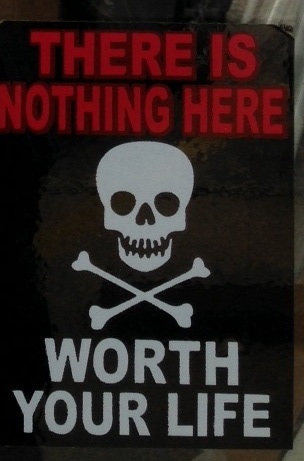
Most interesting perhaps is this sign, and its implicit death-threat. In terms of normative language, it’s worth noting that the sign is a simple declarative. The reader is left to infer the appropriate normative conclusion.
Nothing_worth_your_life2

(Thanks to Wayne Norman for the picture.)

Gas Station Normative Density

car_van_postHere’s an example of what I like to think of as a “normatively rich” location. Alternatively, you might think of it as a clusterfuck of signage. The picture was taken at a gas station in Mitchell, Ontario. Not surprising to find normative richness at a gas station, really. After all, it’s one of the few public places that allows the public to play with explosives.

Anyway, this cluster of signs is worth breaking down and looking at one by one.

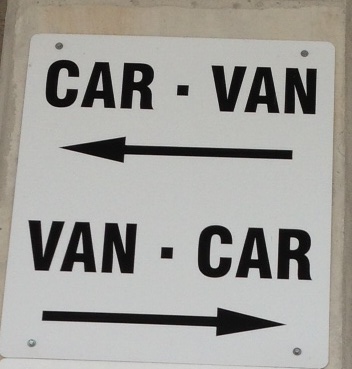
Here’s the first sign, which helpfully tells both van and car drivers that they are welcome to use the pumps on either side. What it doesn’t mention is trucks, which are presumably excluded (but permitted at other pumps, according to other signs not shown here).

car_van_2

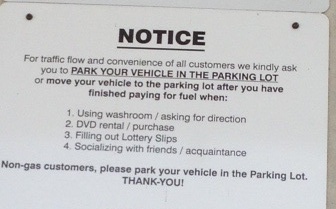
And here’s the second, which asks customers for what is really basic courtesy. In particular, it asks them not to leave their cars parked beside the gas pumps — blocking other customers — while they go inside use the washrooms, buy gum, or whatever.

car_van_notice
Finally, here’s a warning sign. You have to love a warning sign with footnotes. You can click on the image to see a larger version, and if your eyes are good you can read the footnotes. But really, who cares? The point is: footnotes? Seriously?
car_van_caution

(Thanks to Tracy Isaacs for this photo.)

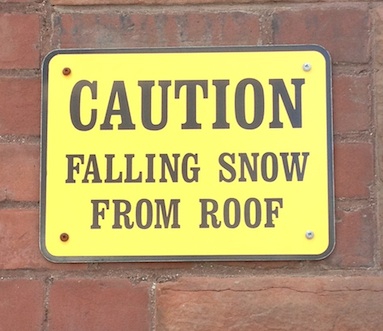
Falling Snow From Roof

snow_falling2This one really is like poetry.

“Falling Snow From Roof” sounds like a fragment of a normative haiku of the 5-7-5 (syllables) kind. A very Canadian haiku, that is.

I mean, it has to be poetry, since the more natural bit of prose would reverse the words “falling” and “snow.” “Caution: Snow Falling From Roof.” Or maybe it needs punctuation. “Falling snow! [From where?] From roof!”

Seeking Disabled, Non-Smoking Females?

female_disabled_nonsmokingThis one (submitted by Tracy Isaacs) is from a courthouse in London, ON. It’s noteworthy for a couple of reasons. First, its use of the word “female” (rather than “women”) is unusual though not unique.

Second, the combination of signs is interesting: female (with the stereotypical skirt-wearing woman pictogram), and the ‘disabled’ logo, and the ‘no smoking’ logo. When I first saw this sign, I was genuinely baffled as to whether the prescription here is a conjunction or not: is this a bathroom only for disabled women? Or is it for women, including those who are disabled? Tracy says it’s probably the latter, given that it’s the only women’s washroom around, and is of the multi-stall variety. Either way, no smoking!

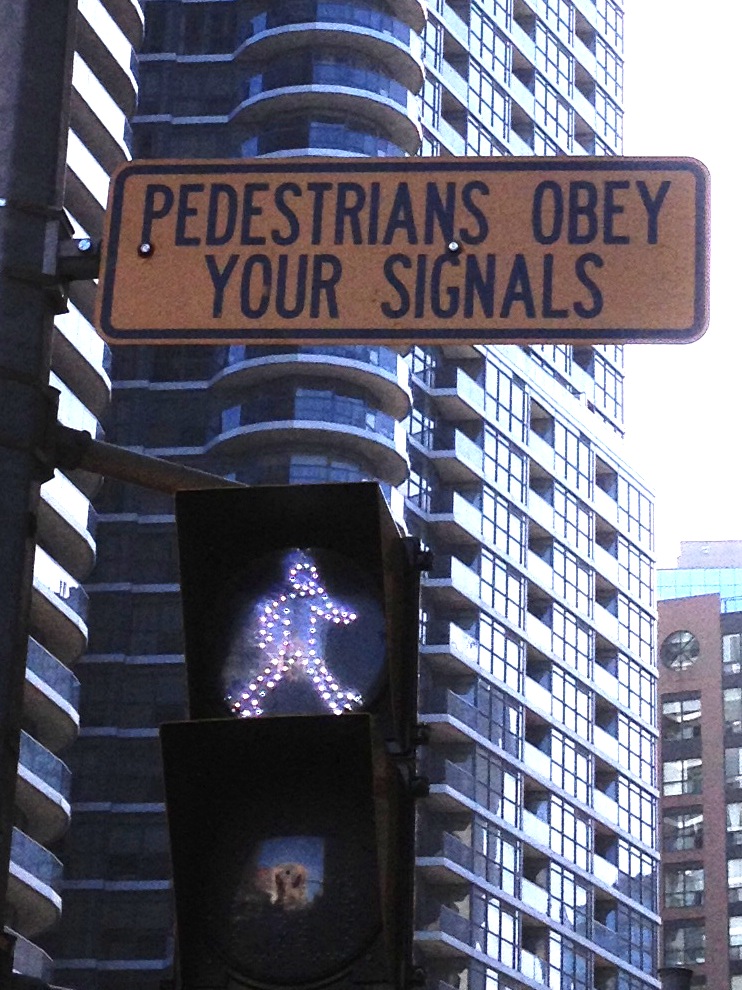
An Obey the Signs Sign

obey_signs2I love this sign, which is posted near the building formerly known as Maple Leaf Gardens, on Carlton St in Toronto.

It’s a sign that encourages pedestrians to obey traffic signals, which are of course themselves a kind of normative sign. So, it’s a sign telling you to obey signs. Philosophically, that makes it a meta-normative sign.

I have to wonder about the likely effectiveness of such a sign. I mean, if a pedestrian wasn’t already disposed to obeying signs and signals, would they be disposed to obeying this particular sign? Maybe there’s a kind of bootstrapping at play, here: its a verbal reminder to obey other kinds of visual signals. So maybe (another metaphor) it serves to ‘prime the pump.’

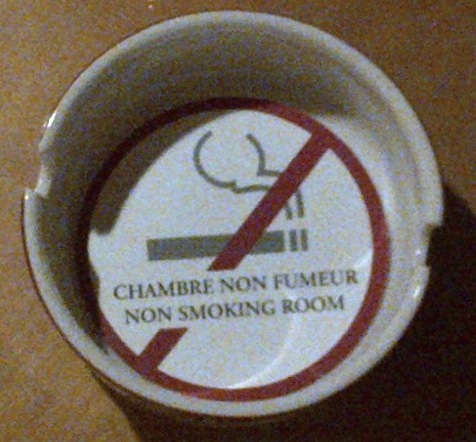
Ashtray Gets All Ironical

no_smoking_ashtray2My pal Jim sent this one, taken in a hotel room (in Luxembourg). It’s an ashtray with a “no smoking” sign in it.

Is this a mixed message? A form of tacit permission to break official rules? A way of taunting the addict? Or (more likely, I think) a way of catching smokers’ attention, by putting the ‘no smoking’ sign in the one place that every smoker is bound to look?