Normative Signs: The Poetry of "Ought"

In which the author finds beauty in how people tell other people what to do.

Life Preserver — Life in Prison?
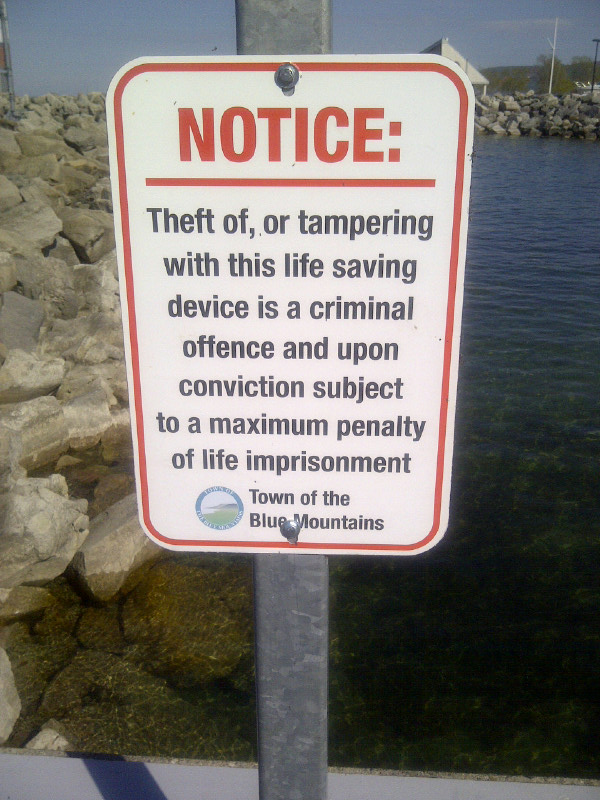
bluemountainsThe picture was submitted by David Groskind, who says it was taken at a dock near Collingwood, Ontario, and that the “life-saving device” was missing when the picture was taken. As he points out, it looks like the very severe penalty threatened by the sign — life imprisonment — was insufficient deterrent.

David and I both had doubts that the stated penalty is accurate. But apparently we were wrong. According to a lawyer friend:

Criminal Code of Canada Section 430(2) Every one who commits mischief that causes actual danger to life is guilty of an indictable offence and liable to imprisonment for life.”
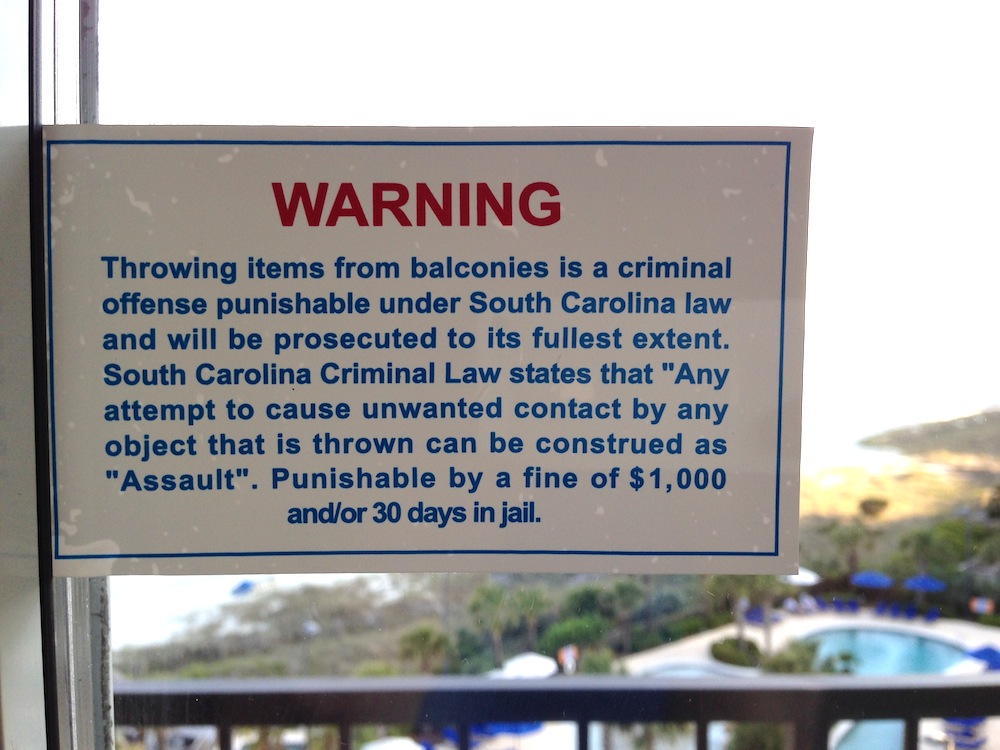
It Might be Illegal to Throw Stuff from Balconies

no_throwingHere’s an instance of a normative sign that apparently attempts to gain additional legal leverage by means of legal sleight of hand. It’s on the window of a hotel room — presumably hundreds of hotel rooms — in South Carolina.

The first sentence says,

Throwing items from balconies is a criminal offence punishable under South Carolina law and will be prosecuted to its fullest extent.

The second sentence says,

South Carolina Criminal Law states that ‘Any attempt to cause unwanted contact by any object that is thrown can be construed as Assault.’

But wait! The first sentence was presumably about throwing anything from the balcony. The second sentence is only about throwing stuff at people. So, launching beer bottles into the pool from the 7th floor at midnight? Go for it!

(Note also the faulty punctuation — the quotation marks. Does no one proof-read a sticker that’s going in a few hundred windows?)

Thanks to Wayne Norman once again.

No Parking Any Time or Anytime

Any_time

anytime
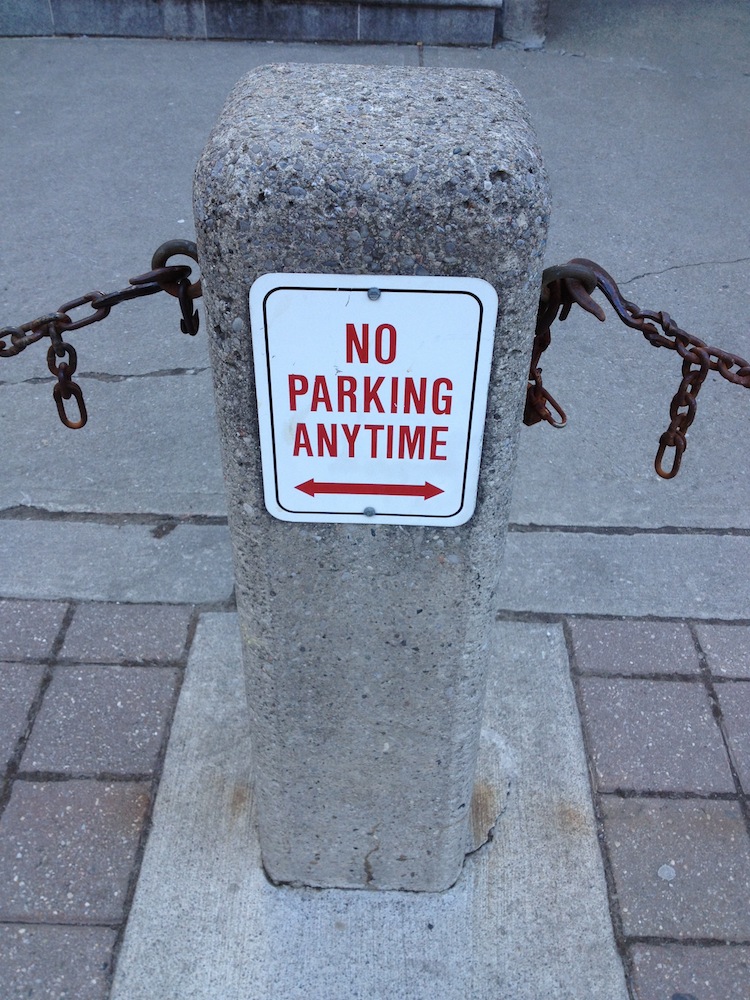
It’s not my intention to make this into a “grammar nazi” blog, but I couldn’t resist here. The two signs above — one correct (on the left) and one incorrect (on the right) are physically located about 30 feet apart, on Bond Street in Toronto. Presumably they mean (or are intended to mean) the same thing.

Parking Suspended

parking_suspendedThis lovely sign was shot in London, by Nancy Walton.

What’s of interest here is the polite footnote, which reads “If this suspension is unclear, or is not being used, please call…” and gives a phone number.

I love the commas (students, take note!). And I love the invitation to, you know, give us a call if anything should be unclear. What’s unclear to me is what it would mean for a parking suspension not to be “used.”

parking_suspended2

Eternal Danger

eternal_flame

Thanks to Paul Gorbould for this one.

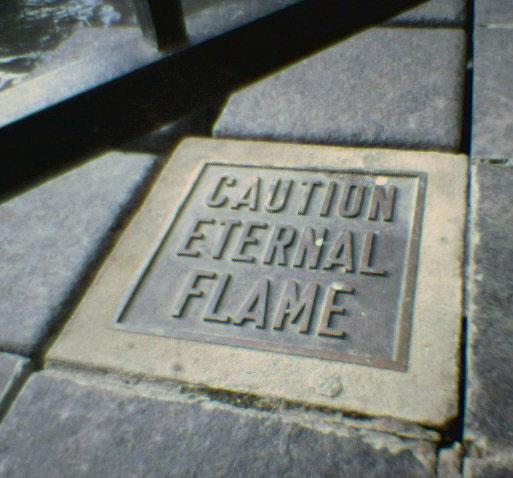
It’s a plaque by the “eternal flame” in the Peace Garden outside Toronto’s City Hall. As Paul points out, it’s a safety warning “in classy, timeless brass.”

Paul goes on to say: “What I find striking is the decision to include the adjective. Is an ‘eternal’ flame more dangerous than a ‘normal’ flame? Practically speaking, it’s probably less dangerous — it has always been there and always will be. At least it’s predictable.”

Danger: There’s an Obvious Danger Here!

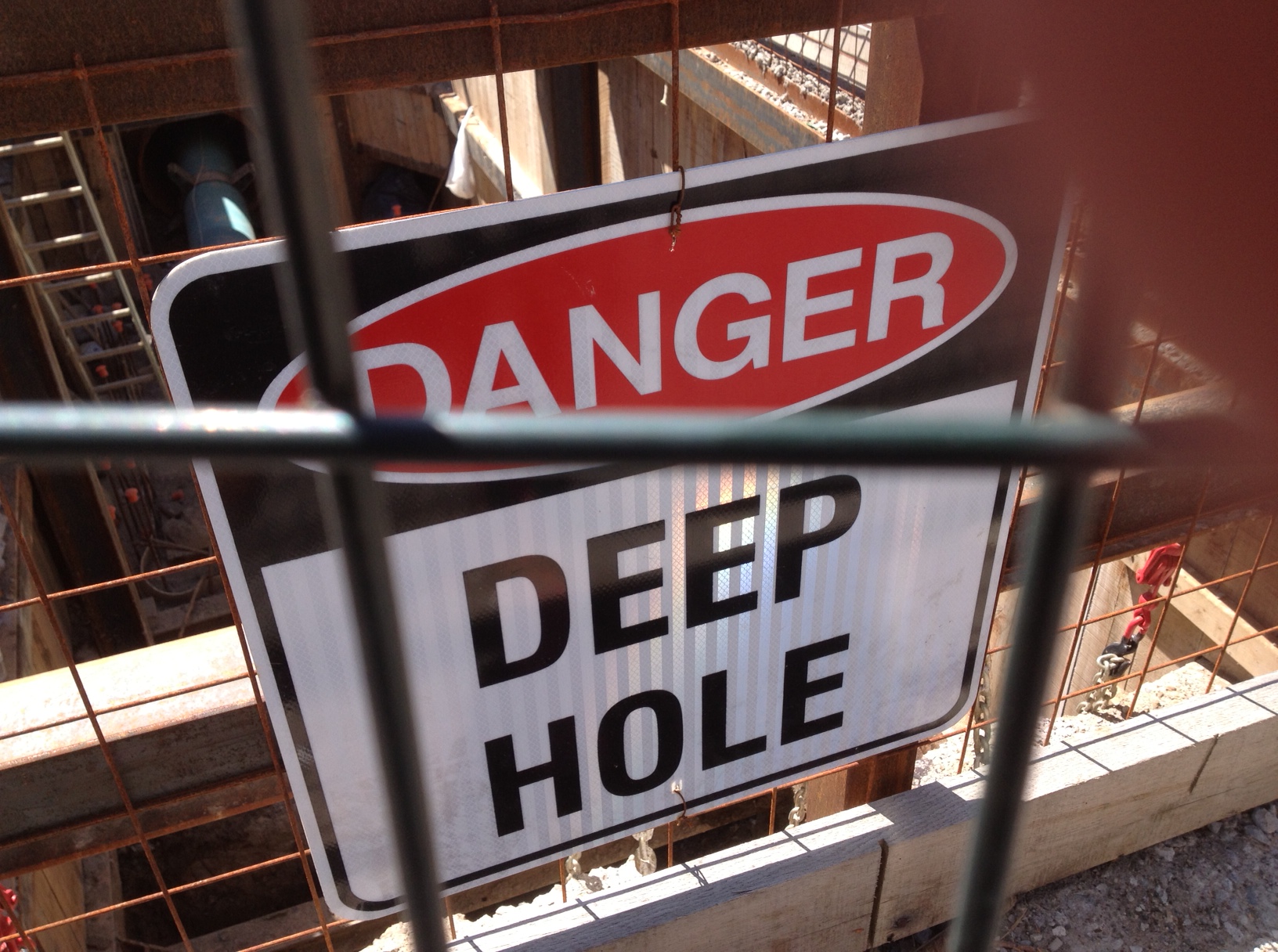
deep_holeThis one is fun. It points out something terribly obvious — namely that there’s a very large hole in the street, maybe 10 feet wide and 20 feet long and 12 feet deep, and then adds the strikingly obvious fact that this giant hole constitutes a danger to pedestrians.

Oh, and note not one but two layers of fence between pedestrians and the dangerous, deep hole.

Interestingly, the normative conclusion — “stay away” — is left implicit.

Walk Left, Stand Right

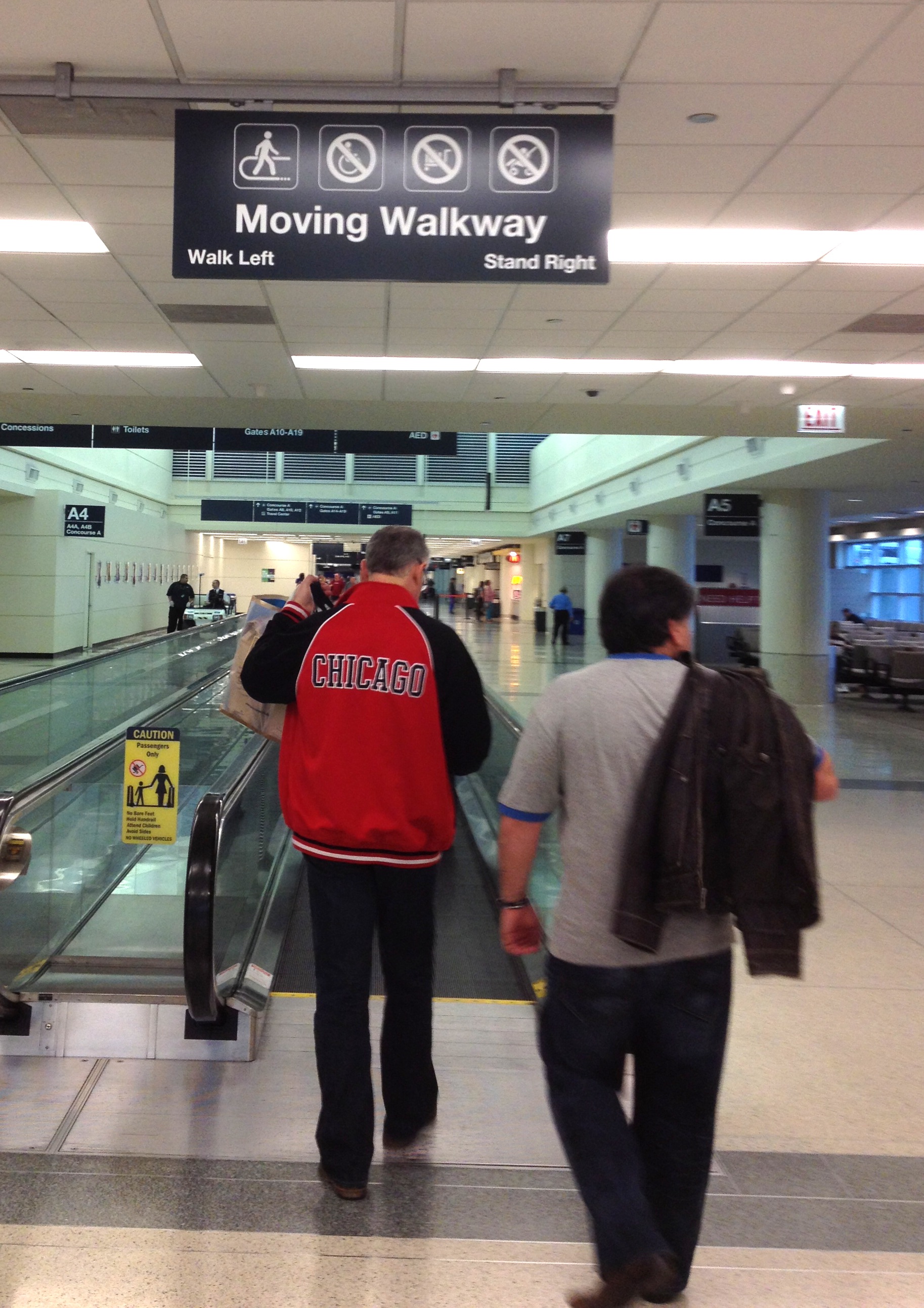
Walk_leftThis is an example of an incredibly important category of normative signs, namely signs that promote adherence to a mutually advantageous coordinative convention. Ignore the pictograms at top, forbidding wheelchairs, etc. Focus on the words at lower left and lower right.

It’s not clear that walking on the left side of the moving sidewalk, and standing on the right, is anything like a rule in the strongly prescriptive sense. It’s just a good idea. Everyone — walkers, standers, and those sprinting to catch their flight — benefit if the standers squeeze to the right, allowing those in a hurry to hustle past. Technically speaking, it’s an equilibrium strategy for a social coordination game.

In some places, this convention is taken for granted, part of normal social expectations. In other places, like an airport with international flights, a nudge is a good idea.

This picture was taken at Midway airport, in Chicago.
Walk_left2

Please Don’t Die

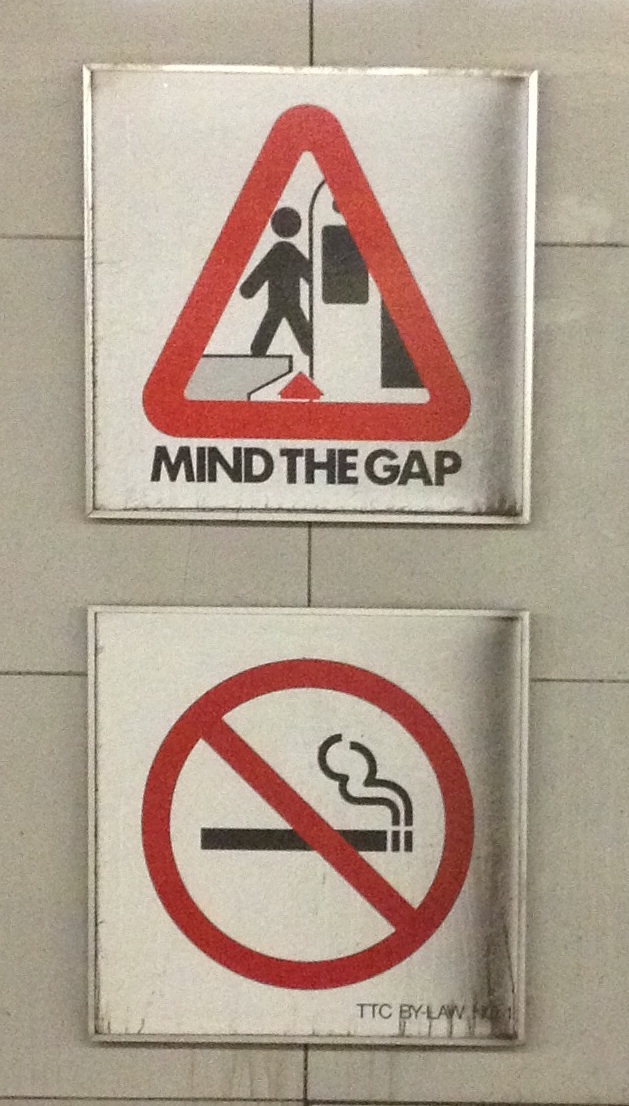
dont_die2This is in a subway station in Toronto. It’s the pairing of signs (I don’t know whether it is intentional or not) that I find interesting.

In essence, the authorities who posted these two signs are effectively asking people not to kill themselves in either of two ways — one fast, one slow.

More seriously: it’s also interesting that the normative force behind these two signs is quite different. The lower one — No Smoking — has the force of law, and is backed by fines. The upper one — Mind the Gap — is “merely” very very good advice. Does pairing them like this have some effect on the psychological force of one or the other?

dont_die

Walk Up One Floor

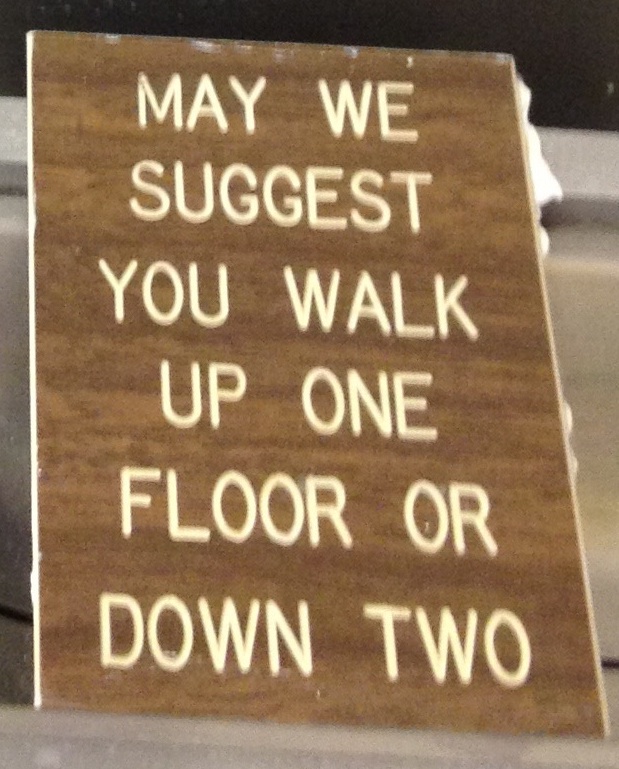
walk_one_floorThis one is pretty much the exact opposite of the one I posted yesterday, which mysteriously encouraged people to use the elevator. This one, posted outside a university elevator, encourages people to walk instead. (Actually, as you may be able to tell from the photo, the sign when photographed was no longer posted, but had rather fallen or been removed, and was now propped on a long-defunct ashtray.)

The sign itself is interesting in two ways.

First, there’s the oh-so-polite, “May we suggest….” It’s good to be polite, here, because after all the elevator is right there to use, and is for many the default, and besides some people aren’t able to use stairs.

Then there’s the very specific suggestion that, if you’re heading up a flight, you can probably manage that, but that if you’re going down, you could probably do two flights. It’s a nice, principled distinction, and also a moderate one: the makers of the sign aren’t just saying you should take the stairs, regardless, but recognizing that going up stairs is (for most people) more difficult than down.

Please Use Escalator or Elevator

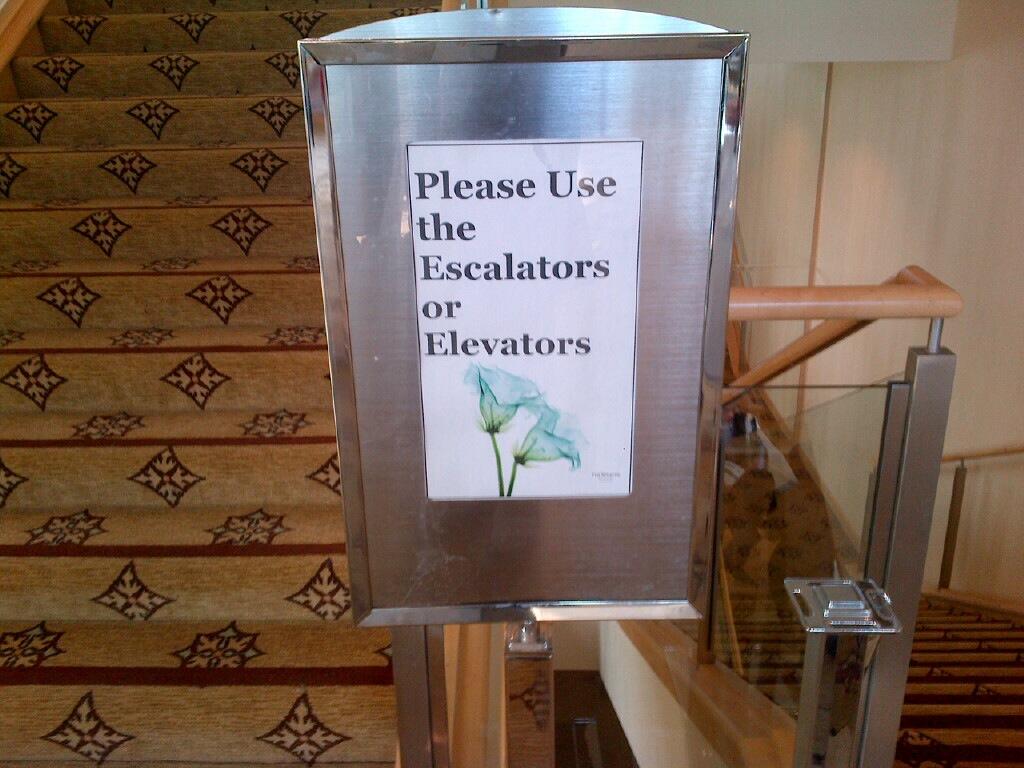
please_use_elevator2This one was spotted at the Canadian Obesity Network Summit, by Dr. Yoni Freedhoff.

That is, as Yoni pointed out, a rather odd place to see such a sign. There, or anywhere. In fact, it’s hard to imagine the purpose behind such a sign. Anyone got a guess? Is the hotel trying to save wear and tear on the carpeted stairs?
please_use_elevator